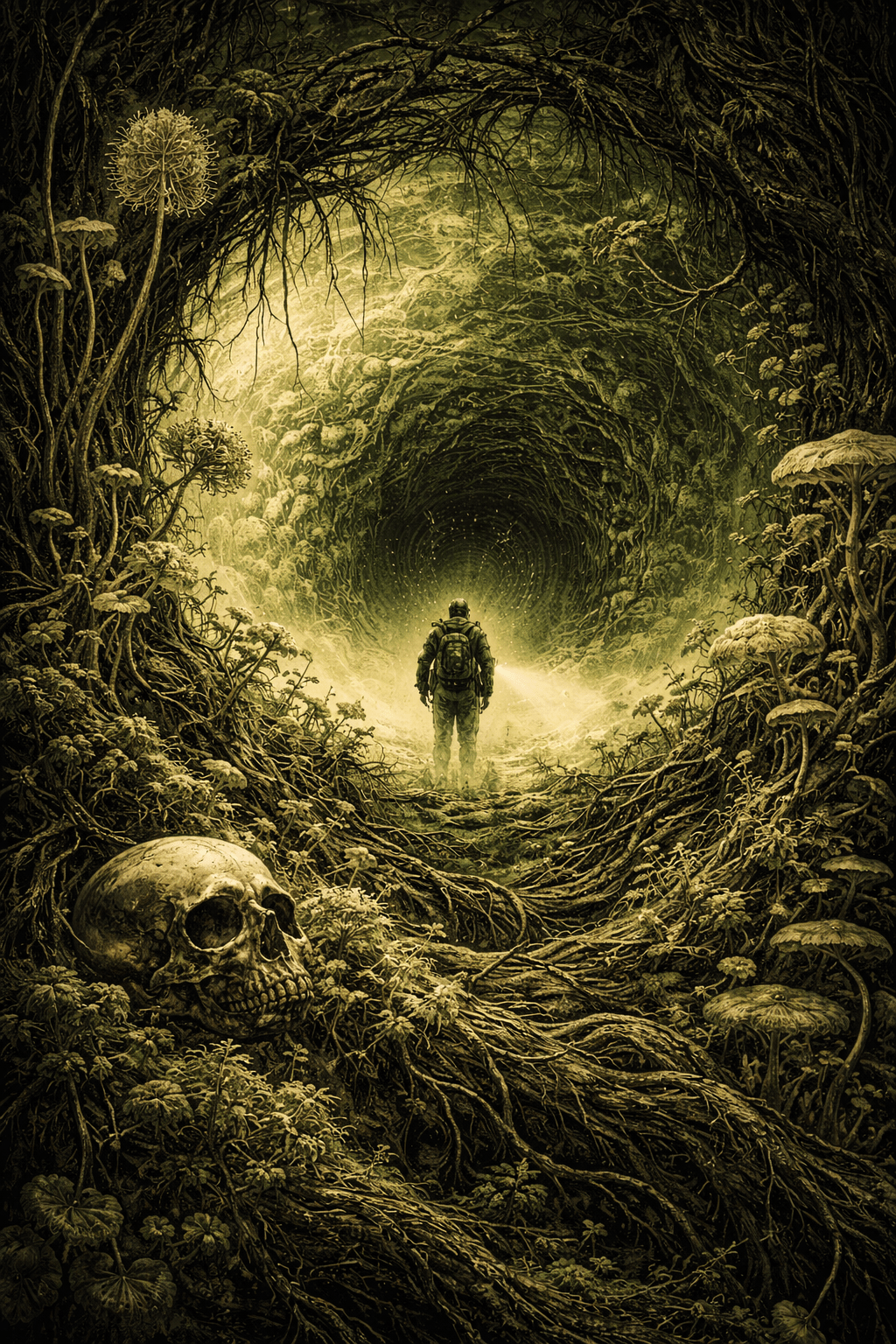
Merlin Sheldrake’s ‘Entangled Lives’ & the ‘Avatar’ movies came in handy while reading ‘Annihilation’ by Jeff VanderMeer. Obfuscating prose & a tendency to not resolve plot points aside, this book carries some of the most vivid imagination I have ever seen in science fiction.
An interconnected world, a self-regulating ecosystem, where parts work for the whole, Gaia if you may, drives the core narrative of the book. That’s why the biologist – the protagonist, is baffled when she analyses samples from herself & the psychologist – she has reason to believe that they simply can’t just be human cells anymore. When exposed to spores, her body had undergone a transformative change that allowed enhanced senses and greater camaraderie with the “whole”. Fungi. It saved her life when she was riddled with bullets courtesy of the surveyor. That’s why the psychologist couldn’t fire at the biologist, was pushed to jump from the top of the lighthouse, and was still functioning on the ground despite breaking every bone in her body. And that’s why the biologist was expecting contamination in their cells – contamination of a fungal kind. “I was convinced that when I wasn’t looking at them, these cells became something else, that the very act of observation changed everything.”
In a way, the transitional ecosystem in ‘Annihilation’ is similar to the ‘Avatar’ movies. Eywa is the spiritual/neural connection for all denizens of Pandora. It is an interconnected network of mycelium that, while it allows a certain agency or independence to its parts, also takes the agency back when faced with a dire threat to its network. Then it pushes the parts to work for the whole. The connection in ‘Avatar’ is more neural. In ‘Annihilation’, the sheer physicality of the connection (on top of the neural connection) boggles you. Human cells and human will are consumed, assimilated, and mimicked in the unlikeliest of places, the living words on the wall of the tower, representing somehow the synergy between parasite and the host. “Assimilator and assimilated interact through the catalyst of a script of words, which powers the engine of transformation.” That’s why the flock of birds – hawks, ducks, herons, and eagles are grouped in a common cause; that’s why boars and human face-shedding creatures veer direction from the biologist at the last moment – the fungal network didn’t want them to attack the biologist. There is no free will this side of the border. The “eruptions” of moss/lichen to human shapes and forms, human cells in the dead fox, dolphins looking through human eyes. The “crawler” is Eywa, with greater, more dictatorial control. Mind-boggling imagination.
You are not truly dead in Area X. Today a human, tomorrow a boar. Parallels to the Hindu concept of multiple lives – not sure whether this was inspired by it, or thought originally.
I did not much enjoy the “camaraderie” between the four characters, or lack thereof. The mystery kept me going. The psychologist was interesting – the element of hypnosis adding one more layer of obfuscation to an already mind-boggling narrative. The author didn’t really want us to understand this book; he wanted the readers to be comfortable with uncertainty.
Fortunately, it is a good, short read. Frustrating at times, a tad depressing, but it makes you wonder – always.
 Alienman