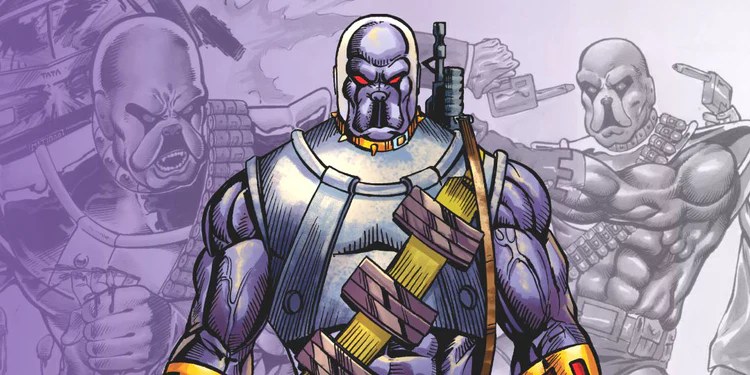
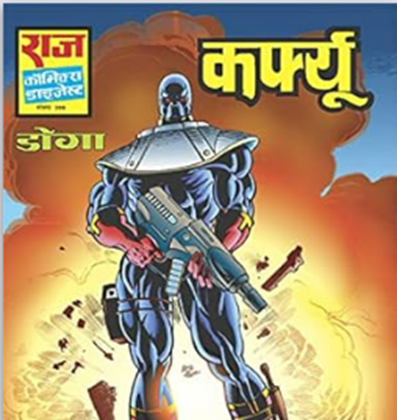
From writer Sanjay Gupta & Tarun Kumar Wahi, and artist Manu, Curfew (Doga #1) introduces us to Raj Comics’ beloved vigilante / anti-hero Doga. An exciting introduction to the cruel, crime-fighting superhero who believes in uprooting the problem itself, rather than fighting it!
I have started a new series of reviewing Indian comic books – as I have seen very few outlets doing so – in the process, trying to revive interest in the indigenous, veritable pop-culture heritage that we have.
Right off the bat (pun intended) – would like to talk about the elephant in the room – whether Doga really is a rip-off of Batman or Punisher? Doga wears a dog-mask, carries an ultrasonic whistle that only the dogs can hear, doesn’t have any vaunted superpowers but sheer brawn, is traumatized early on in life by a tragedy that forces him to don a tight-fitting costume and take on the criminals – how then, is ‘Mumbai ka Baap’ different from the ‘Bat of Gotham’? Curfew only gives a partial answer to this question. This is a 3-parter origin story – with the pivotal, defining moment in our hero’s life happening in ‘Ye Hai Doga’ (Doga #2) – which changes the way the titular character perceives things.
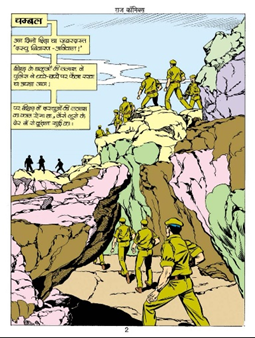
The first introductory panel takes us to the badlands of Chambal – infamous for the many dacoits that erupted out of its ravines. We see cops hot on heels of one dacoit in particular, Daaku Halkan Singh. Shorn of his compatriots who were killed in action, cornered finally – Halkan Singh is all but ready to give up. A crying baby lying in a dumpster becomes his route to escape.
You guessed it right – the wailing, left behind infant – the classic Bollywood trope in the 80s & 90s, goes on to become the crime-fighting Doga. Down in the dumps, an impoverished Bruce Wayne, is he?!
Pointing the gun against the baby’s forehead, Halkan Singh escapes on a white horse right in front of the helpless policemen. Thus, the baby grows up, amongst the ruthless dacoits who exploit, loot and kill the common citizenry of the country. He is all but inured to violence around him, but the writer assures us that ‘in his chest is rising the flood of hatred’ (seene main uth raha nafrat ka sailab).
There is a brief interlude in the origin story here. We cut to future where people of Mumbai are obsessed with the next new thing: Paan Kharaab, a ghutka so delicious that even the kids can’t stop eating. There are hoardings and advertisements, samples are distributed for free – everyone wants to make their ‘zubaan kesari’. While I understand the underlying social message, it’s a funny thing to introduce in a comic series, also this is distinctly Indian. But then Doga is known to fight the social evils of the society, Mumbai in particular. As Batman is restricted to Gotham for majority of his crime-fighting career, so is Doga to Mumbai – fighting more domestic crimes with little time available for intergalactic capers.
And the person behind the paan masala – the man of the hour is none other than Daaku Halkan Singh. He has become old now, with a shaggy white beard and yellowing teeth. His attire has become modern, wearing a long blue trench coat and bowler hat. For some reason, he is seething with murderous anger at the boy he picked up as an infant to escape the cops. He even has a large-ass bullet in the boy’s name – the one with which he vows to murder him when he can find him.
He needn’t have worried because Doga is already plotting his death. The very next panel, we come to know that there are posters on every wall of the city – “Maut ka paigaam” (message of death) for Minister Halkat Singh (Daaku Halkan Singh in disguise) the next day at 2 PM.
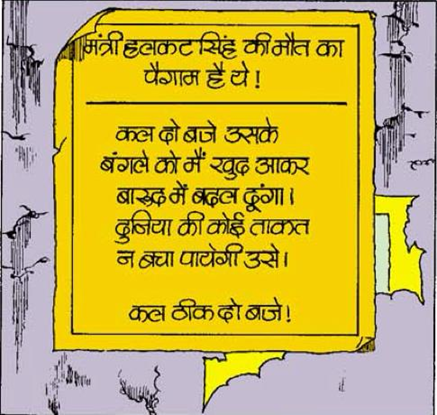
Talk about building intrigue for a hero entry. Again, a classic trope – but very effective. This had to be the highlight of the comic, the anticipation of things about to become exciting. This poster causes a flurry of panic in the Police headquarters and we are introduced to Commissioner Tripathi who begins every statement with “What Nonsense!” English looks a bit funny when written in Hindi lipi – in fact, there are smattering of other English words used throughout – this Hinglish seems to be an attempt to reach out to wider audience and staying relevant, though there doesn’t be a need to do that.
The police decide to enforce a curfew between 10 AM to 2 PM covering five miles from each direction to the Minister’s house the next day. Halkat Singh, is seemingly not satisfied with this arrangement. He instructs the Commissioner that the police should clear the area by 1:45 PM. The police do just that, and at sharp 1:45 PM – there are Halkat Singh’s private Black Cat commandoes manning the perimeter.
Amidst this top-notch security bandobast, Doga wearing his purple dog mask and totting a giant-ass machine gun, with a bullet sash around is shoulders, red chaddies on top of his very purple costume – drops from a very tall building. And just like Rambo, he starts firing at the commandoes with his machine gun. A great hero entry. And kudos to the black cat commandoes for not even putting up a feeble attempt at retaliation, dying without resistance and giving our Doga a great hero / anti-hero moment. He also quite easily sets up a bomb at the minister’s residence (Nobody is at home though “surprise, surprise”), and blows up the place in a huge BANG! Before the police arrives, he escapes in a “helicopter” though I have no idea how does a pauper Bruce Wayne gets his hands on a helicopter – aren’t those things like super expensive?
Doga doesn’t seem to be satisfied with just blowing up Halkat Singh’s house. He visits the hideout where Halkan / Halkat Singh is seething with fury at the masked man. Doga plies Halkan Singh with crucial information about his backstory, how Halkan Singh himself has shaped his personality and reveals his identity. He also admonishes the daaku / minister on peddling the Paan Kharaab to the masses. This gives Halkan Singh sufficient time put the large-ass bullet in the gun and fire at Doga.
Doga doesn’t move out of the bullet’s way, he let’s himself be fired at. Then he chokes Halkan Singh to death in his vice-like grip. Enters Adrak Chacha, a guy Doga implicitly trusts as he finally reels from the impact of the bullet. Chacha asks the question we all want answered – why did he let Halkan Singh fire at him? To which Doga replies that he owed his life to the Daaku when he picked him up from the dump so many years ago. By letting himself be fired at, the life-debt was over. And he himself could then kill Halkan.
The anti-hero collapses. Adrak Chacha picks him up, vowing to show the world why Doga is the way he is – a typhoon of hate, burning bright for the devils of this world.
An amazing, masala entry of Doga – ‘Curfew’ is a must-read for all comic book fans.
‘Ye Hai Doga (Doga #2)’ would shed light on his origin story – then we can know for sure whether he is indeed an Indian caricature of Batman, or a superhero in his own right!
 Alienman