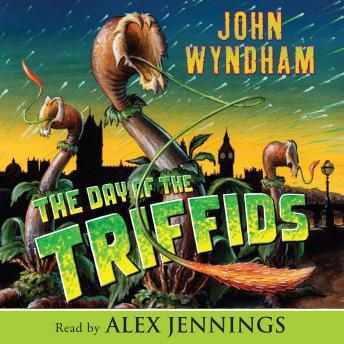
Review: 2 stars
The funny thing is, triffids most certainly do not have their day in ‘The day of the triffids’ by John Wyndham. They are most certainly afterthoughts in a novel that was meant to be specifically about them. The literal and nearly-complete blindness of humanity and the ways in which they deal with it occupies major chunk of the book. Even the protagonist, who is supposed to be a triffid-expert, thinks them more as a background noise than a plaguing concern.
Let’s draw a comparison between triffids and their far, far-flung relatives – zombies. Triffids are parasitical, walking-plants whereas zombies are, well you know all about them. Let me tell you, a world plagued by triffids is a cakewalk compared to those by our bloodthirsty undead. If a zombie attacks a house party, the members would either find themselves infected or cut down to bits and pieces. If a triffid attacks a house party, well actually, it never could attack a house party – if we keep all the doors and windows locked. Its sting would harmlessly hit against the concrete and the wood. One brute quality that a triffid has is patience – it would lie in wait till the supplies run out from the house, and the members of the house find themselves at a juncture where they either must venture out or resort to cannibalism. Even then, the prospects aren’t all so bad. Wear a thick padding of clothes, & a helmet that covers your entire face and you can easily pass through a bovinely menacing crowd of triffids. And it walks at an ungainly trundle – you could easily outrun them. Even if a triffid has managed to sting you, and you find yourself dead – it would take a triffid a very long time to consume every ounce of nutrient out of you. It would install itself besides your dead body and spread its roots firmly in the ground, and slowly suck out every vitamin and fat in your body as you putrefact.
Of course, triffid weren’t of humongous concern to humanity till it went blind. Even when it did, the greatest enemy of men and women were men and women, loneliness and paranoia second and triffids a distant third. In these pages, you find the author’s inept ramblings against feminism, more amusing than a full-fledged triffid attack. There is a sociology professor in this book, who suggests that for the society to survive and flourish in the aftermath of tragedy that had befallen humanity, every sighted man should work outdoors, every woman should take care of kids and household chores, every blind man left for the dead, and a sighted man of course must bed at the very minimum, 3-4 women (sighted and blind). So much for male fantasy! It is passed as the only logical alternative to feudalism and tribalism, and at the very end of the book, such a society does evolve and flourish. While I would very much like to be a part of such a society if I were a sighted man, I don’t see how it is the only logical alternative. It is after all a game of supply and demand. If say, 90% of the world is blinded and only 10% of the population is sighted – given our skewed sex-ratio, sighted women would be lesser in numbers than sighted men. Hence every woman must bed 3-4 men (sighted and blind) at the minimum to repopulate the planet after say 25% of humanity is wiped off by triffids and suicidal frenzy. Also, because there are more men than women, some of them must also perform household chores. But why have this structure at all, where the sighted must chuck out the blind and make do only with those who can see. There is a possibility that both sighted men and women venture out in the big bad world, the blind men and women take care of household chores and the cottage industries (in the beginning till the time they are better-trained), and nobody is hard-pressed to churn out more babies as we aren’t writing off the population that is blind.
In another passage, the author compares women in not so many words to parasites as they live off the labor of the menfolk who dirty their hands while they live in blissful dependence. To me, these two ideas sound contradictory – on one hand, he suggests the only logical alternative to global doom is women taking care of the babies and household chores, and wresting and fighting with other wives for male attention while on the other hand, he rails against women slacking off in the household. One thing is clear, while the author considers women good only to perform household chores and raising of kids – he doesn’t even think that these tasks are worthy of merit.
Overall, the book was a mighty bore. All of this could have been prevented if the triffids had just a bit more bite!
 Alienman