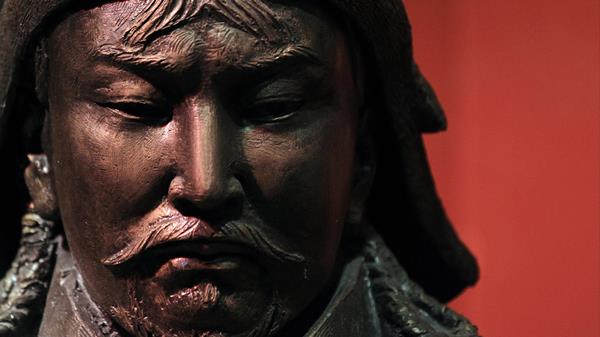
Review: 4 stars
Let me tell you from the very outset, Genghis Khan was not a Muslim who perpetrated various acts of violence against the people of India. Furthermore, he even failed to mount a conquest on India as he found the weather to be too hot. Genghis Khan was a Mongol and a shaman who believed in the ‘eternal blue sky’. Though other Mongols adopted Buddhism, Christianity and Islam, he himself stayed true to his roots, while establishing a secular state which extended from Russia to Afghanistan, & from Vietnam right to the doorsteps of Europe. Genghis Khan and his descendants unified Russia (Batu and the Golden Horde), China (Khubilai Khan), India (Mughals) and altered the dynamics in the Middle East (Ilkhanate dynasty).
He was brutal, effective, open-minded and a dynamic leader. From inner steppes of Mongolia, a man from a small and insignificant hunting tribe would one day trounce the Germans, the Jurched dynasty of China, lay waste to the kingdom of sultan of Khwarizm through fiendish military techniques, superior technology and collective intelligence, defeating armies many times larger than his own. Jack Weatherford’s ‘Genghis Khan and the making of the Modern World’ gives a learned, if a biased account of the rise of Genghis Khan and his descendants, as they come to dominate the world in the 14th century which has been dubbed by historians as Pax Mongolica. His emphasis on trade, predominance of state over religion, military prowess, freedom of religion and good-old horse sense revitalized the trade across ‘the Silk road’, bringing prosperity and stability to the region.
More than anything else, Mongols burst the bubble of European society. After reading this book, one can only glean the narrow-mindedness, self-centeredness and utter ignorance of a monolithic, Christian society – namely Europe, and how miniscule its impact was on the rest of the world in the earlier 11-14th century. Yet retrospectively, once they had ruled the very many, colonies around the world in the later-half of the millennium – they tarnished and ridiculed the advents of progress in Asia that acted as a precursor to their own industrial revolution.
The accumulated wealth of knowledge of the Chinese, the Arabic and the Indians – of mathematics, medicine, art, warfare, agriculture, printing of books, paper money and calendars, sciences and what not – was delivered right to their doorsteps through the reinvigorated ‘Silk road’. And after the dismantling of this trade route following the bubonic plague (which historians believed originated in China & which traversed through this route), Christopher Columbus convinced King Ferdinand of Spain to sponsor a sea expedition to reestablish a contact with China and India. Inadvertently he ended up discovering America, and incongruously he ended up calling its people Indians.
Moreover, the Chinese claims over Arunachal Pradesh, Vietnam, Korea, Laos, Cambodia, Myanmar, Aksai Chin and many other territories are partly due to the unification of China under Khubilai Khan, the grandson of Genghis Khan – who established the Yuan dynasty. Though the Chinese believe that they have the “historic” rights to these territories, they forget that they themselves were ruled by a foreign, Mongol dynasty which unified all these territories under central power. Mongolia should be claiming these territories including that of China. What China is suffering from is a massive bout of nostalgia, as it wishes to mirror the ‘Silk Road’ through the CPEC corridor, and establish control over the countries once under the Yuan dynasty.
History is never simple. Going beyond black and white, Genghis Khan played an important role in shaping the modern world. This is an authoritative book on the lives and times of the Mongols and their influence on the world. It is a must-read for all those interested in the politics and history of Asia.
 Alienman