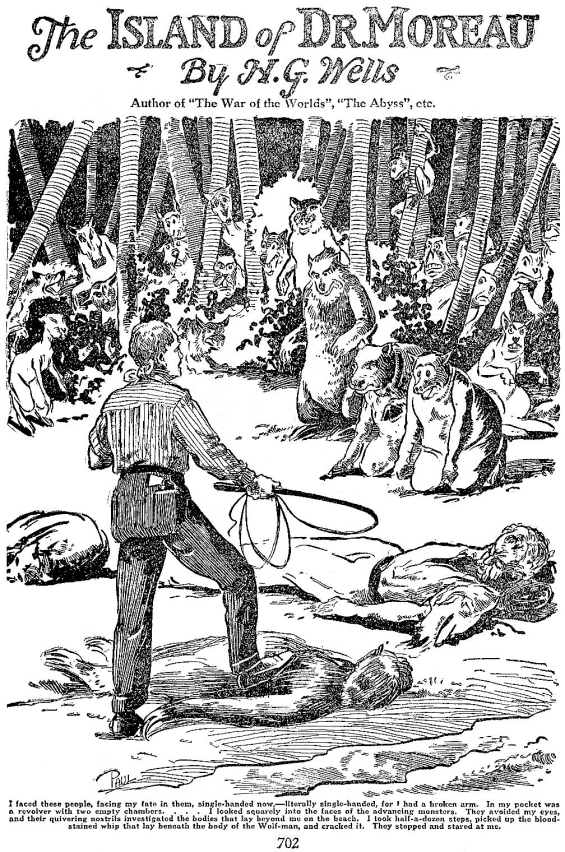
‘The island of Doctor Moreau’ reminds me of the robots in the Isaac Asimov novels, and the three laws of robotics. The first one goes something like this, “A robot may not harm a human being, or through inaction allow a human being to come to harm.” There is a similar but a more selfish law that the vivisected transmogrified animals follow, selfish because the creators have formulated it to save their own hides. The animals may not crawl, or eat flesh, and treat their creators as nothing less than Gods.
But it was not the similarity that struck me, but the difference. When a robot grows more conscious, it considers the spirit of the laws of robotics, and decides to save humanity and not just a human. Either the malfunctioning robots flout the letter of the law or the hyper-conscious ones like in the ‘I Robot’. But the animals in ‘The Island of Doctor Moreau’ flout the laws when they resort back to their inherent animalism. When the basic instincts take over the implants in their brain (n outlandish concept – the idea of implants on brain to make them conscious, its modern analogy being recoding/rewiring the brain), they attack the humans for flesh. Eventually, they degrade back to the animals they were, in their strange, hybrid, cross-animal, grafted bodies.
Another thought that strikes me while reading the book is the issue of ‘Vivisection’ or the ‘experimentation on live animals’. London was in a thick of a debate on the issue, when HG Wells published this work. Should this inhumane cruelty be allowed on animals if it benefited humans in the long run (medicine, surgery)? But Dr. Moreau was on a different tangent altogether – he doesn’t consider the implications of his research, just his pursuit as a selfish, keen and a curious enquirer into the laws of nature. He, as a coldly rational man, is remorseless to the pain he inflicts on the animals. While I believe that Wells mostly tilts against ‘vivisection’ – there is still a high degree of speciesism in the book. Moreau and Montgomery consider them to be superior to those animals, while the protagonist Prendick is reviled and disgusted by them even though he is averse to the pain caused to them during the grafting procedure.
This, like the other works of Wells, operates in the moral grey area and it is upto the reader to draw his conclusions on the moral issues one way or the other. Otherwise as a novel, it is quite racy, entertaining and edge-of-the-seat material if you can overcome the hoariness of the language.
 Alienman