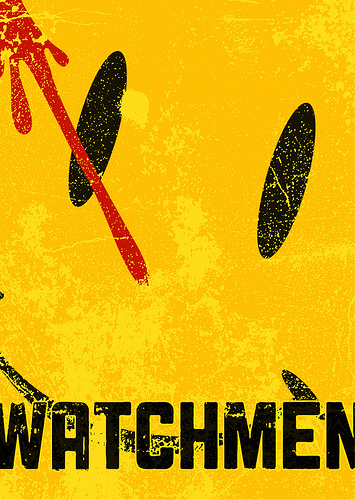
Like all great books that I have come to admire, it all started with a rejection. I rejected Harry Potter, because I believed him to be yet another wannabe magician who would pull out a rabbit from his hat. Rejection actually helps – it is a sifting mechanism, though improper, which allows me to focus on stories which I might tentatively like. But it also disallows me another perspective, which might broaden my horizon beyond what I had ever imagined. Such was the effect of Harry Potter on me, and such is the indelible mark left by ‘Watchmen’ by Alan Moore.
Parallel stories, masterfully crafted and skilfully knit – to give you a perfectly cooked meal for your mind, this book forces you to ponder and reflect. Easy Conspicuousness isn’t the mark of a true artist. She doesn’t have to explain you everything, or dumb it down enough for a normal being to understand. Throughout the reading, I could capture, though barely, the intangible undercurrents featured in each of the panels – there are layers in each one of them. One is visible to the naked lazy mind, the other layer is hidden – visible only to the patient and discerning. Not that one requires a particular skill to flesh out the Easter eggs, it’s just that you have to spend considerable time with the book.
A flight of fancy is easy, diligent and consistent imagination is much more difficult. The philosophical underpinnings, the sheer range in the character profiles, the realism and the subjective veracity of each individual – there is the range (that every other Superhero Comic Book/Film has), and depth (which I believe only Christopher Nolan’s Batman has captured). I am truly a convert. Today, I admire the panel art and the prose more than the paragraph. Condensed text and graphic imagery can say more than the descriptive imagery that a paperback generally employs. I also now respect the medium in which the story is told, though story has to be the primary benchmark here.
That leads me to the question – can you really conjure up an image while reading a novel? I mean to say, suppose a fight scene is going on – can you imagine each and every uppercut and feint, each jab or a riposte? What the author pens down, and what the reader discerns – is there a loss of information in transit? Wouldn’t it be easier to empathise with the picture of a crying woman, than with the description of her plight? I understand at this point, that the reader would feel that not everything could be captured via pictures – context setting (as to why she is crying in the first place), and the literary interplay doesn’t find its way in the graphic novels and movies. The Harry Potter movies (though sheer pleasure to watch) are skin-deep. The books are much more in-depth. In this regard, I believe that ‘Watchmen’ is rich despite being condense, descriptive while being laconic. It narrates less, yet tells quite a lot. You have to tune in to the right frequency to hear the song. But then, this is no ordinary graphic novel.
I have been toying with the idea of combining video with text for quite some time. In writing, there is a cardinal rule, ‘Leave out the part that people skip’. But the context setting is vital, though terribly boring for the reader. What if we intersperse videos with text, and effectively use the power of both the media – it would be a ‘Moving Novel’, one step ahead of the graphic novel, and a richer offering than a ‘motion picture’. It’s like the ‘Pottermore’ (earlier version), but with more text. A much more entertaining and engaging medium to read than the ‘Cell Phone Novels’ and a hell lotta richer. I believe that might be the true disruption the publishing/media industry is looking for.
Only if one could pull off a ‘Watchmen: The Moving Novel’. I would try. It’s worth the attempt.
 Alienman