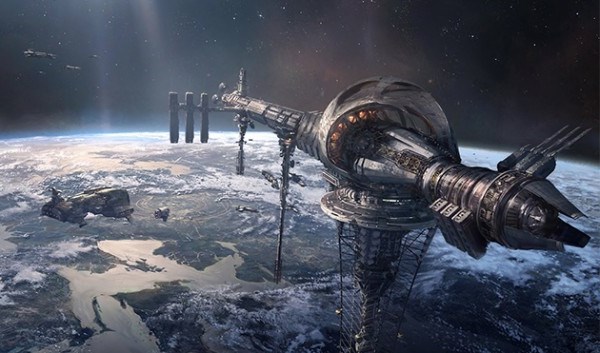
Space, the final frontier. We wax lyrical about the immense possibilities of space: Martian Colonies, Base Camp on the Moon, the wonders of the Titan, Asteroid Mining, and what lies beyond the realms of this Solar System. Our strong and unassailable faith in human endeavour has brought us so far ahead, that we have been able to transform some aspects of the figments of our imagination into reams of reality. But already we are seeing the interest, dwindling. Our age hasn’t yet produced another Isaac Asimov. Public opinion is increasingly set against space programmes, they want their governments to be more interested in people, than in Space. As a result, Government cut-backs are hurting Space Agencies, worldwide. Even as we watch ISRO’s success stories in frugal engineering with immense pride, there is already a section of society which feels that this money could have better served the underprivileged. I doubt the veracity of their logic, but I fear that at the altar of knee-jerk, myopic public opinion (reaction!), Science would be sacrificed first!
So what’s the alternative? Privatization of Space? The rich technocrats of Silicon Valley either want to be Space Explorers or Philanthropists! A remarkable thing, indeed! Back home, they still want to be Angel Investors, but the fad will catch up in our country as well! But, for how long would such greenhorns be able to pump in money? Space Technology is a complex, exact and a ruthless Science which won’t forgive you for a slight mistake or a lack of foresight. Optimism would give way to increasing frustration. Significant results wouldn’t be achieved overnight! Once they see their monies draining with no significant achievement in sight, they would simply move on. They still may be able to contribute to the Space Technology, but the scope is limited. I am not doubting their passion for space, but this model is simply not viable.
So what is a viable business model for Space? Yes, the key word here is ‘Business’. The sanctity of the shrine called Science has to be thoroughly corrupted and utterly defiled with the crudity of business. Space has to be privatized, there is no doubt about that, but the public still, has to be invested in the idea of Space Exploration. Only then can it be truly viable. Only then can we set the trajectory of the growth of Space Exploration from ‘tentative’ to ‘inexorable’. The Governments don’t own the Space, neither do the Industrialists, alone. In the “assumed” absence of another intelligent species, the Space collectively belongs to all of us. We are the true masters of the Universe. So how to bring about a sea-change in the public opinion? How do we, the science enthusiasts, get people to claim their piece of moon? How do we get them personally invested in the idea of Space Exploration? History can still teach us a thing or two.
As Niall Ferguson, in ‘The Ascent of Money’, strives to explain what an amazing financial invention ‘The Company’ is, I realize how amazing it would be, if we have a stock exchange/ a commodity market of sorts for all the Space enterprises engaged in the launching of spacecrafts!! After all, the European Conquest of the Asian and the American continent had been possible only due the invention of ‘Joint-Stock’ and ‘limited liability’ companies with a robust secondary market wherein such shares could be bought and sold freely. What if we have a Space Bourse, headquartered somewhere on moon, with traders of all ilk, standing with bated breath, waiting for the safe return of Redstone, an asteroid-miner, filled to the hilt with meteoric iron ore?
‘Did you hear, the transponder of SpaceX’s latest Saturn Orbiter stopped communicating with the Earth Base? Dude, the share prices plunged. I got out before the going got really tough.’
‘Man, those guys at MEADA hit pay dirt. Titan has so much gas, man! Cheap crude, baby!’
I notice your worried looks, readers. You feel that this is all fine, we would be able to build a sustainable financial model which would provide a firm backing for technological innovations that would bring us all the useful minerals and hydrocarbons from the space, but is that all there is to Space? What about truly exploring the space, trying to really colonize the wide swathes of planetary systems, lying far beyond?
Before addressing that issue, let me underline few of the most important breakthroughs that we would achieve from this systematic commercialization of Space. First and foremost, would be the communication methods. Remember, this is Space we are talking about and nothing can go faster than the speed of light, so a typical Space Stock Exchange market would be far from dynamic, moving at extremely sluggish speed. I can already imagine the drab, bored faces of the traders, with there being hardly any transaction for months. Decades might pass, before there could be any movement in the stock price of a particular company specializing in the mining of the Oort Cloud comets . Remember, a shuttle might have exploded in Space, but it would take some time before we could really confirm whether it had truly gone bust. The only way in which we could introduce some vibrancy in the market, is through multiple launches, round the clock, round the year. Also the ships would need to ping back information continuously, every few minutes or so, so by the time the first message is relayed to us, we would then get a hour-by-hour (or minute-by-minute!) status report from the ship, though the information might be a tad bit outdated.
Traders hate information deficit. That’s why people who exploit the market, on the basis of inside information, are so thoroughly punished. Information network has to be clean, robust and must be able to handle large volume over mighty distances. This would lead to a flurry of innovations in the communication techniques, and an expanded network of telecommunication towers stretching from Mercury, all the way to Alpha Centauri!! Multiple channels would have to be established for communication which could simultaneously keep tabs on all our investments in Space, checking their health time and again.
Not only that, there would be a targeted focus on ensuring the safety and well-being of our spaceships. Building ships is a costly affair, and though we might have drastically reduced costs of building one through continued innovation, it still would represent a big investment. Of course, we would be buying shares of a big Space Enterprise, which would be sending out space-pods/crafts every other day, so a loss of a particular satellite won’t significantly dent the resources of the company. But still, we might be playing with trillions of dollars (if dollar is a base currency, then). So, the crafts would be build with highly durable materials, there would be numerous safety mechanisms installed and we could also establish numerous safety kiosks (a hospital for crafts!) on the highway called Space, where any malfunction probe returning from a particularly tricky part of the space would be restored back to its original vitality on its way back to earth. Thirdly, our crafts would be built for speed and for bulk storage. For a truly flourishing commodities market, there must be goods involved. And though it is granted that the goods may arrive at a future date, the buyers would still like to see their investment reach home early, and in bulk!! So better haulage would make the expedition financially viable and speedier transport may have the effect of significantly reducing the travel time.
Because there is still a massive amount of risk involved, there must be a provision to guarantee the survival of the company itself. A high-stake investment must not destroy the company; such large Space companies have to bounce back, otherwise it would plunge the entire world economy into a dire recession! Hence, a vibrant insurance market would come into play, wherein each craft and pod could be insured (based on the calculated probabilities), for which the Space Companies would pay a premium to the Insurance Companies (Government-backed or otherwise). Not only that, as we would be so much concerned about the future, and we earlier talked about a commodities market, Hedge fund managers would have a very vital role to play, dealing with various types of future securities and commodities, effectively complementing the insurance companies.
Does this mean, that we are now solely concerned with extracting precious ores and scooping up hydrocarbons for usage on Earth? Is Space, one big commercial enterprise? Remember, it was out of a very selfish motive that the Europeans set out to conquer the rest of the world. They solely wanted to get rich. They wanted our spices and condiments. They wanted a slavish populace which could till their cotton farms. This post won’t get into the debate of the rights and wrongs of the European conquest, but one must understand, that this very selfish pursuit resulted in a worldwide exploration. Today, we have a fair idea of the places around the world, we have dived the deepest oceans and scaled the highest mountain peaks. The inadvertent side-effects of the conquest of the rest of the world, led to a knowledge expansion. It also brought the world together.
So, even if Space is reduced to a one big commercial enterprise, I won’t lose much sleep, as ‘To infinity and beyond’ is a given. Human colonies would be established. Though a sizeable chunk of personnel out in deep space would be mechanical men, humans would have to man crucial sectors of space where ingenuity is required. So life-systems and habitable pods would be developed.
But of course, these traders won’t be interested in the study of origins of our Universe. Though Engineering would flourish, the scientific study of Space would be on a backburner. One way of solving such an issue would be to not entirely do away with Governmental Space Enterprises. They would still play a huge role, when it comes to basic science. The funding though, remains a tricky aspect. What the government could do, would be to issue Space Bonds on the behalf of such Space Agencies, wherein the fund generated would be used to further the interest of Science. Today, the exploration of space is still, mostly a government enterprise. They have the necessary technology and wherewithal to actually conduct such space trips. So when such agencies engage in pursuit of Science, they would have build for themselves a mighty stash of patents and copyrights. They could then receive royalty payments from the private companies for the transfer of technology involved. Because organizations like NASA have a head start over and above the private companies, all their deep-spacecrafts would have crossed the precincts of the solar system (Voyager 1 left the Solar system, in 2013). So the initial mapping of the universe would be done by NASA and ISRO. They could then sell the data to private companies, if they come across a dwarf planet loaded with minerals and ores. What I am trying to say is that such agencies should raise money from the institutional investors by issuing bonds, which they would utilize to deepen our understanding of Space and time, and any potential revenue stream generated through royalty payments or through mapping of space, could be utilized in interest payments. Remember, Space Agencies might not be obliged to pay back the original invested amount (such bonds can be issued for eternity), they would be simply have to make regular interest payments. As and when there is a requirement of additional funds, more bonds can be issued.
There would be a booming realty sector. Though terraforming industries would come at a much later stage, habitable living pads could still be established on surface of the moon. Banks could affect the payment of such housing schemes, wherein the particular pad could be used as a collateral by the owner. Such Housing Finance banks would become incredibly large, with so many assets strewn across the space. Banks would also provide funding for our own personal pods which we might use in zipping across space at an even clip.
Financial revolution goes hand-in-hand with technological revolution. New financial innovations might occur at a future date which we are unable to grasp at present, just as new technologies are bound to emerge. What I have tried to convey, in my utter naiveté, in the above passages, is that there are ways and means of converting public resentment into public investment. Public resents government spending on Space Infrastructure, because the money involved represents the tax payers’ money. If they were instead to issue Space Bonds (the institutional investors like the insurance companies ultimately get their money from the general public) or constitute a Space bourse, public would readily invest money for sound returns. Why should public foot the bill for Space expenditure, make them the stakeholders in tomorrow’s growth!!
Don’t appeal to the apparent goodness of the people, appeal to their inherent greed. Only then, can we truly become the daring space explorers and colonizers!
 Alienman